
The Zero-Click Reality → Ch. 2: Why GEO Starts With Credible Measurement, Not a Monday-Morning To-Do List
August 4, 2026 · 9 min read
If you read my last piece on the "Zero-Click Reality," you already know that slapping your legacy SEO strategy onto generative AI is like trying to use a highway map to navigate a deep-sea trench. You understand that AI models don't retrieve links; they synthesize answers.
But we have a collective strategic blind spot. Understanding the physics of a black hole does not automatically teach you how to build a spaceship - and that’s where the real challenge begins.
Once founders and marketing VPs accept that Generative Engine Optimization (GEO) is real, the most common question I get is: "Okay - what do we actually tell the content and dev teams to do differently on Monday morning?"
Stop right there, because that is the wrong first question. Before asking "what do we do," you must ask, "how would we know if it worked?" In GEO, measurement isn't a footnote to figure out later. It is your foundational strategic move, and if you skip it, everything downstream is just guesswork in a lab coat.
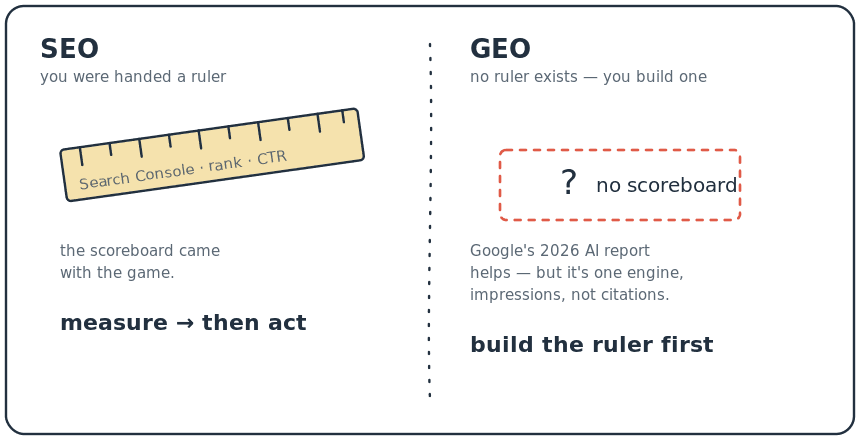
In SEO, you were handed a ruler. In GEO, you have to build one.
The Asymmetry Nobody Names
The transition from SEO to GEO reveals a glaring asymmetry. Traditional SEO didn't just come with tactics; it came with a built-in measurement substrate. Google Search Console handed you impressions and positions straight from the source. Rank trackers turned "where do I sit?" into a chartable number. SEO strategy could begin at the tactical level precisely because the ruler was already in the room.
GEO inherits none of that infrastructure. There is no console telling you how often ChatGPT recommends your product, and there is no simple rank for "the answer."
FIELD NOTE
A Note on Google's Recent Update: Yes, in June 2026, Google added a generative-AI view to Search Console, and you absolutely should turn it on. But look closely at what it actually provides. It is limited to Google (remaining entirely silent on ChatGPT, Claude, Gemini's app, and Perplexity). It counts mere impressions - not whether you were cited in the critical sentence that mattered, nor how you were described. Furthermore, it completely misses the preliminary data, like which prompts relevant to your brand are actually being used.
Relying on this limited view is like reading the weather in one city and calling it the national forecast. The reality remains: the ruler won't be handed to you. Building it is step one, not step ten.
The Broken Meter: Why You Can't Just Count Clicks
When faced with this lack of native tooling, the natural reflex is to rely on existing web analytics: "I'll just count the visitors coming from AI in GA4."
This doesn't work, and the reason is structural. When a user clicks a link inside an AI assistant, the referrer data that normally identifies their origin is routinely stripped by the app or in-app browser. Without a referrer, GA4 automatically files the visit under "Direct," lumping your AI-driven traffic in with people who typed your URL from memory.
While ChatGPT occasionally tags some links with utm_source=chatgpt.com, platforms like Perplexity, Gemini, and Claude are wildly inconsistent and often tag nothing at all. The scale of this blind spot should stop a CEO in their tracks.
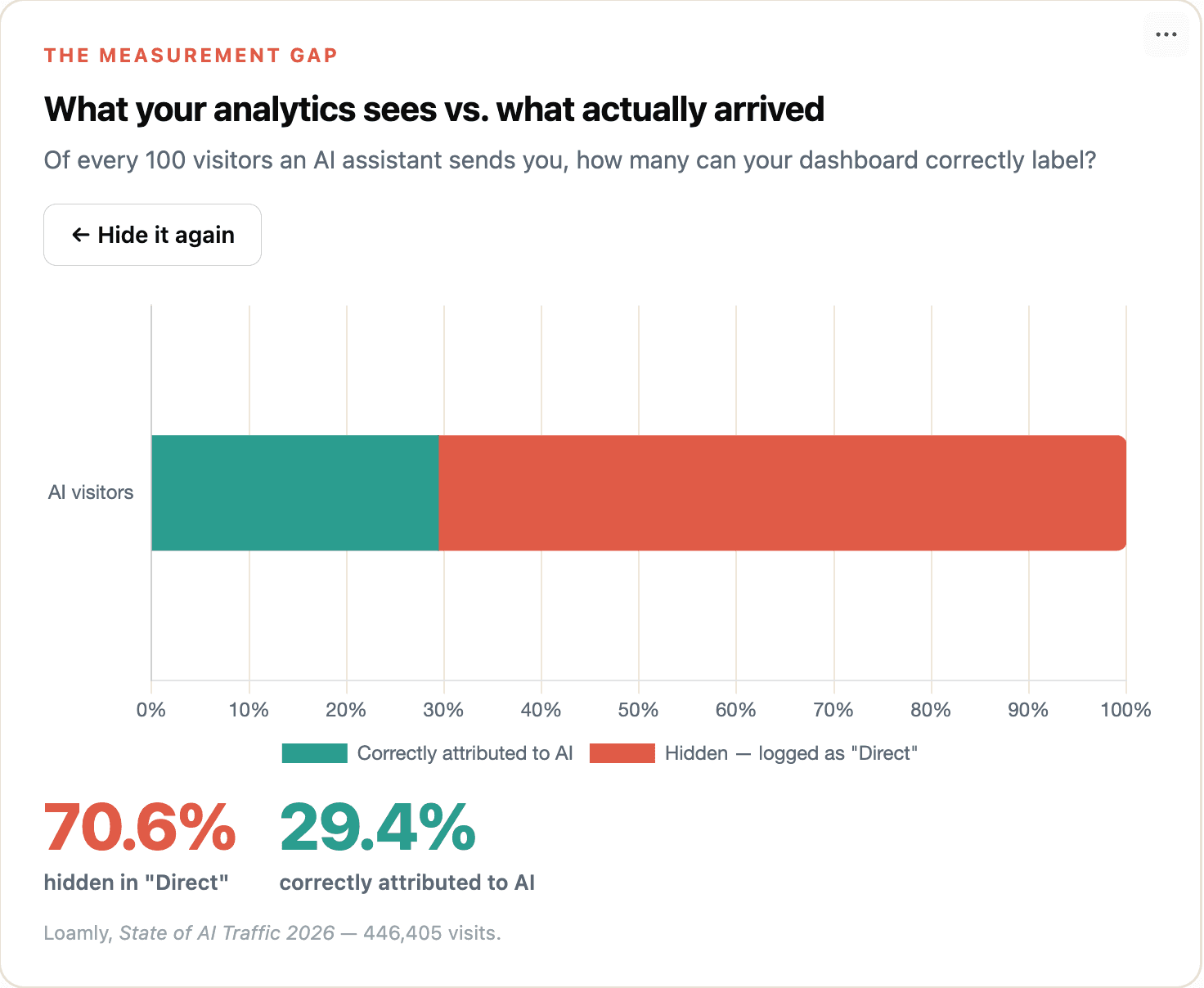
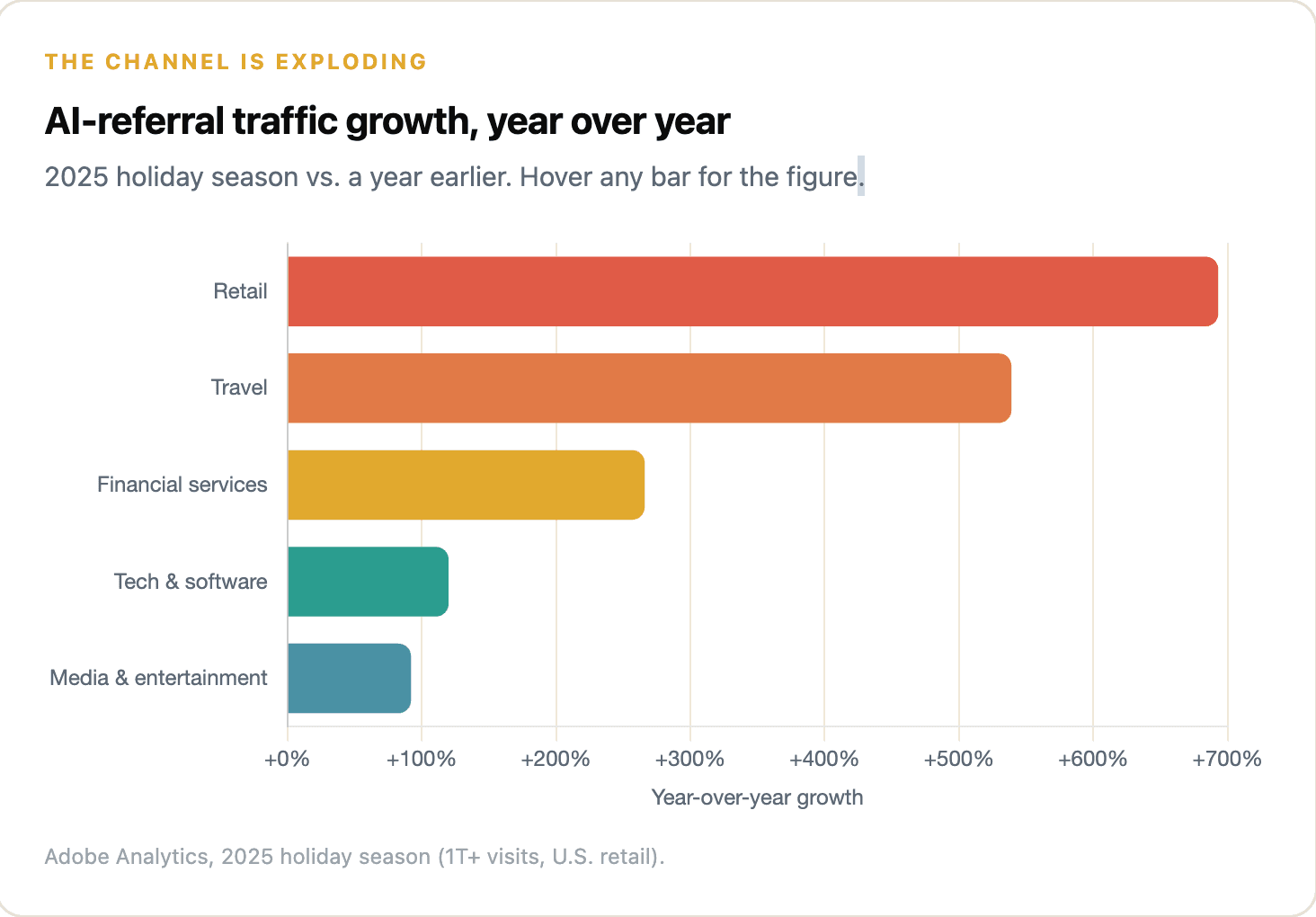
Loamly's State of AI Traffic 2026 benchmark, drawn from 446,405 visits, found that 70.6% of AI-driven traffic arrived with no referrer header - that’s roughly seven of every ten AI visitors miscounted by GA4 as "Direct," lumped in with people who typed your URL from memory. Now set that against Adobe: its Analytics data, spanning more than a trillion visits to U.S. retail sites, put generative-AI referrals to retail up 693% year over year across the 2025 holiday season, after climbing more than tenfold between July 2024 and February 2025.
We are looking at a channel exploding in size, measured by an instrument that misses two-thirds of the activity. It is like an altimeter reading a third of your actual altitude while you are climbing.
Even a Perfect Click-Counter Measures the Wrong Thing
But let's look at the deeper issue. Even if you could magically fix every attribution gap tomorrow, you would still be measuring the wrong variable.
Recall that roughly 83% of AI-Overview searches end without a click. The true value of GEO lies in being present inside the answer - recommended, cited, and framed well - precisely where nobody clicks. Referral traffic only ever sees the visible tip of the iceberg; the real influence lives in the submerged mass that fires no session and writes no server log line.
Therefore, "how much traffic did we get from ChatGPT?" is the wrong KPI, even when it can be answered. The right metric is Share of Model: When the machine is asked about our category, how often are we in the answer - and how are we described?
That is a property of the generated text, not your server logs. You cannot measure it downstream; you must observe the model directly.
Measure Like a Pollster, Not a Fact-Checker
Observing the model directly is where a decade of experience with these systems makes me twitch, because I see how often people get it wrong. Too many marketers will screenshot a single ChatGPT answer that names their brand and call it a "result."
That is not a measurement; it is an anecdote with good lighting.
An LLM is not a traditional database returning a fixed record. It is a probability distribution that you are sampling. If you ask the same question five times, you might get three different answers: cited once, dropped the next run, and back with different sources minutes later. Add in overnight model updates, and the entire surface shifts.
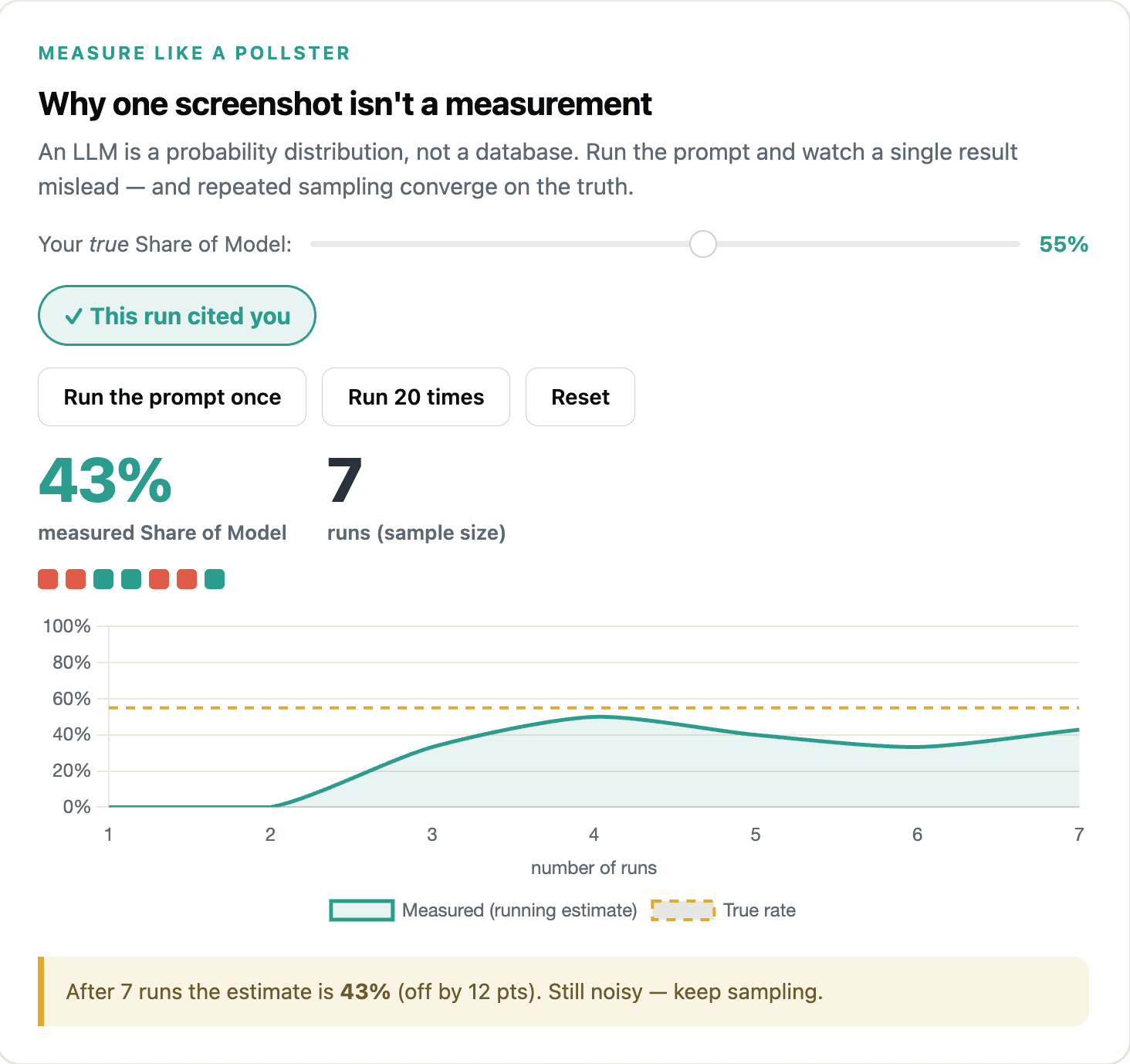
Because of this volatility, you must measure AI visibility the way a serious pollster measures an electorate: through a designed sample, not a single phone call.
The Polling Playbook for GEO:
- Run high-frequency samples: Current research (like the 2026 "Don't Measure Once" study) recommends about seven runs per prompt, per day.
- Build a diverse portfolio: Relying on one or two prompts only measures the quirks of those specific queries.
- Test across engines over time: You must track performance across multiple LLMs to get an accurate aggregate view.
- Report with humility: Use confidence intervals instead of the false precision of a single, static number.
This fundamental gap - between a rigorous poll and a fleeting vibe - is the entire reason Relevant exists, and it is the standard to which we hold our own measurement.
The Trap of the In-House Build
On a whiteboard, capturing this data looks like a straightforward sprint: write some prompts, build a script to hit a few APIs, and dump the results into a table. Unfortunately, that naive estimate is where most in-house GEO measurement projects quietly die.
The hard part was never the code. The complexity lies in the execution:
- Sourcing the Right Prompts: Your measurement is only as good as the portfolio behind it. The questions real buyers type do not live in traditional keyword tools. A keyword is two words; a prompt is a paragraph, and they barely overlap. Building a representative set means mining how your market actually talks through support tickets, sales calls, and community threads. Furthermore, it is never finished because phrasing drifts as AI tools evolve.
- Handling Conversational Context: A clean prompt ("Best CRM for small teams") and a messy, conversational one ("We're a 12-person agency on HubSpot, it's gotten too pricey, what should we switch to?") are entirely different animals. They pull different answers, cite different sources, and surface different brands because the latter carries context. Most in-house scripts - and many commercial GEO trackers - only test the tidy version of an untidy world, handing you a confident, yet inaccurate, number.
- Maintaining the Data Pipeline: Stacking the necessary sampling (seven-plus runs per prompt, per engine, per day) requires a robust parser that can extract mentions, competitive share, framing, and accuracy from free-form text, then deduplicate it into a trend. That is not a weekend script; it is a living system that can break with every overnight model update.
This is the honest case for buying over building. It is not that your team can't build it; it is that a serious product has already absorbed the tedious, breakable parts of the process and goes far beyond basic tracking.
The ultimate point of measuring is to improve. The right tool carries you to the next step, shifting the narrative from "Here is your Share of Model" to "Here is why the model isn't citing you, and here is exactly what to change." That is the difference between a thermometer and a doctor.
What We've Been Quietly Building
We are building Relevant to be the measurement layer that GEO has been missing - a pollster-grade instrument, not a screenshot generator.
Relevant sources the prompts your real buyers use, tracks the multi-turn conversational queries that most tools ignore, and samples every major model with required rigor. Most importantly, it executes the step that actually moves your business: it tells you why the models cite you (or don't) and what to change to win the answer.
FIELD NOTE
A plain caveat: This discipline is young. Methods are not entirely standardized, and the underlying engines shift constantly. Anyone selling you a precise "AI visibility score" down to the decimal is overselling. Treat the data as a directional compass - which is precisely why you need an instrument maintained by a full-time team, rather than a script you cobbled together on a Friday.
We stayed quiet while we got the science right, knowing the last thing this space needs is another dashboard flinging confident numbers with no substance underneath. That patience is nearly up. If measurement is the first move in GEO, we intend to be the instrument you reach for first.
The brands that start measuring accurately now will compound a year-long lead while everyone else argues about whether this shift is real. If you would rather see your Share of Model before your competitors see theirs, get on the list at gorelevant.ai. We are about to make a lot of invisible things visible.
Notes on the Data
- AI Traffic Misattribution: ~70.6% of AI-driven visits arrive with no referrer or are misattributed as "Direct." This is based on an analysis of 446,000+ visits, noting partial utm_source tagging by ChatGPT and inconsistency across Perplexity, Gemini, and Claude (2026 GA4 attribution studies).
- Google Search Console Generative-AI Report: Launched June 3, 2026, rolling out to a subset of sites. Tracks impressions/pages for AI Overviews and AI Mode for Google surfaces only.
- AI Referral Traffic Growth: ~693% YoY for U.S. retail during the 2025 holidays; >10x growth across 2024–2025 (Adobe Analytics).
- Zero-Click Rate: ~83% on AI-Overview searches (Semrush, 2025).
- Sampling Guidance: ~7 runs per prompt per day using diverse prompt portfolios, as recommended by "Don't Measure Once: Measuring Visibility in AI Search (GEO)," 2026.
About the Author
With 10+ years deep in the tech and data science trenches, the author is currently building Relevant. When they aren't mapping the mechanics of AI search or building data-heavy inference models, they share unfiltered insights here on the future of search, demand modeling, and generative AI.