
From Backlinks to Information Gain: The New Rules of AI Search
August 11, 2026 · 4 min read
For fifteen years, the backlink was the currency of search. Authority flowed through links; whoever collected the most won the traffic. Generative engines don’t count links. They count novelty.
ChatGPT, Gemini, Perplexity and Google’s AI Overviews have already read the internet. They can synthesise anything that already exists. So they don’t reward the most thorough page - they reward the page that adds something the others didn’t have. That “something” has a name in the research: information gain.
Here’s the uncomfortable test: if every fact in your article already lives in today’s top ten results, your information gain is zero. You won’t get cited no matter how well you rank.
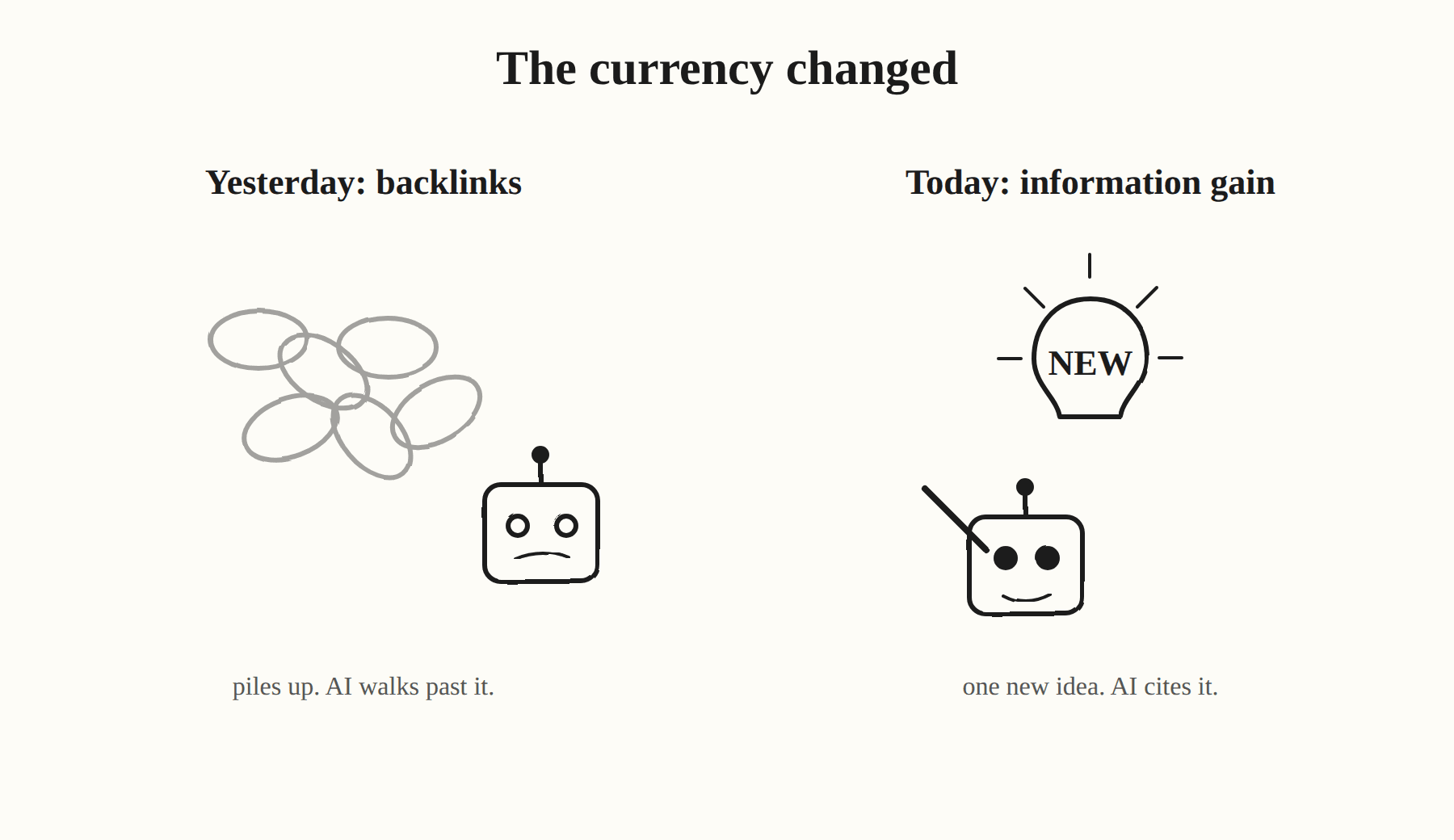
This isn’t a hunch. It’s in the research - and in a patent.
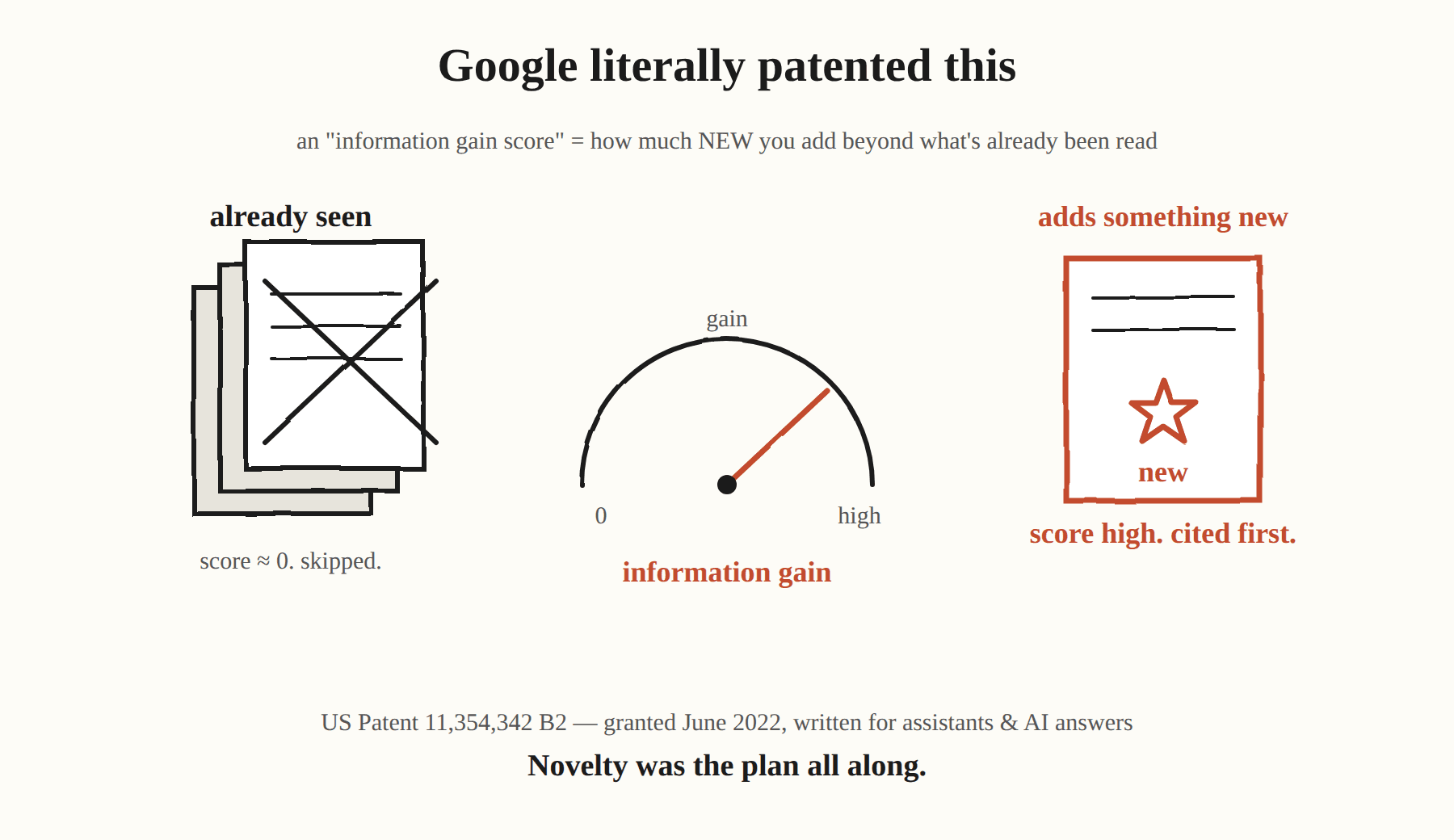
Start with the part almost nobody quotes. In June 2022, Google was granted a patent titled “Contextual estimation of link information gain” (US 11,354,342 B2). It scores a document by the “additional information… beyond information contained in documents that were previously viewed by the user” - and it’s written explicitly for automated assistants and AI answers that serve sources one after another. In plain terms: the machinery that decides what to cite was built to reward what’s new to it. Novelty wasn’t an accident. It was the plan.
Then the measurement caught up. Princeton’s GEO: Generative Engine Optimization study (Aggarwal et al., KDD 2024) ran roughly 10,000 queries across nine datasets. Old-school signals like keyword stuffing barely moved citation odds. What worked was adding credible statistics, direct quotations and cited sources - lifting AI visibility by up to ~40% in the strongest cases.
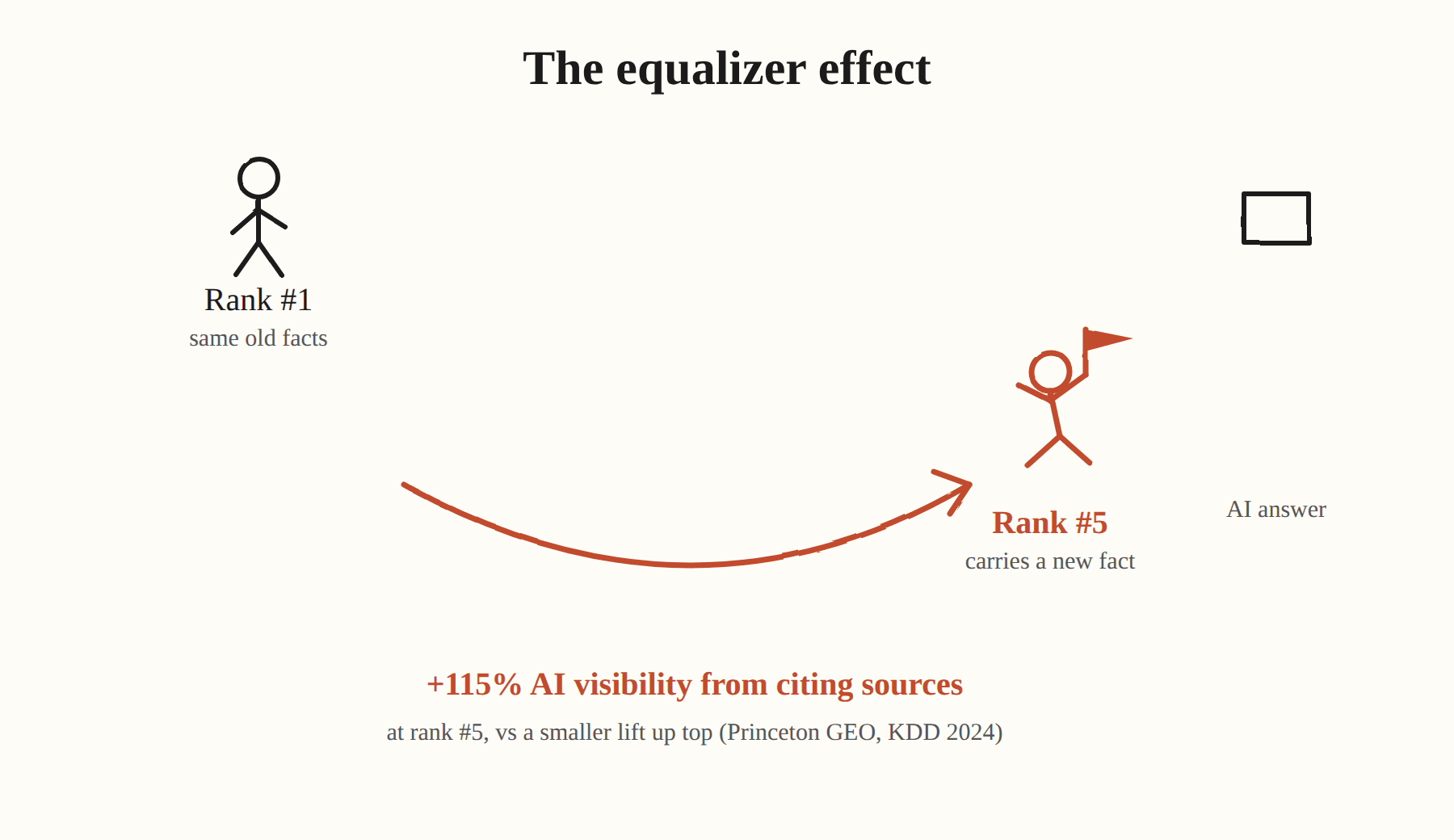
The stranger finding was an equaliser effect. A page sitting at position five saw a 115% jump in AI visibility from citing sources alone - a far bigger lift than the page already ranked first. You don’t have to outrank the giants. You have to out-differentiate them.
The ‘Content Bloat’ era is over
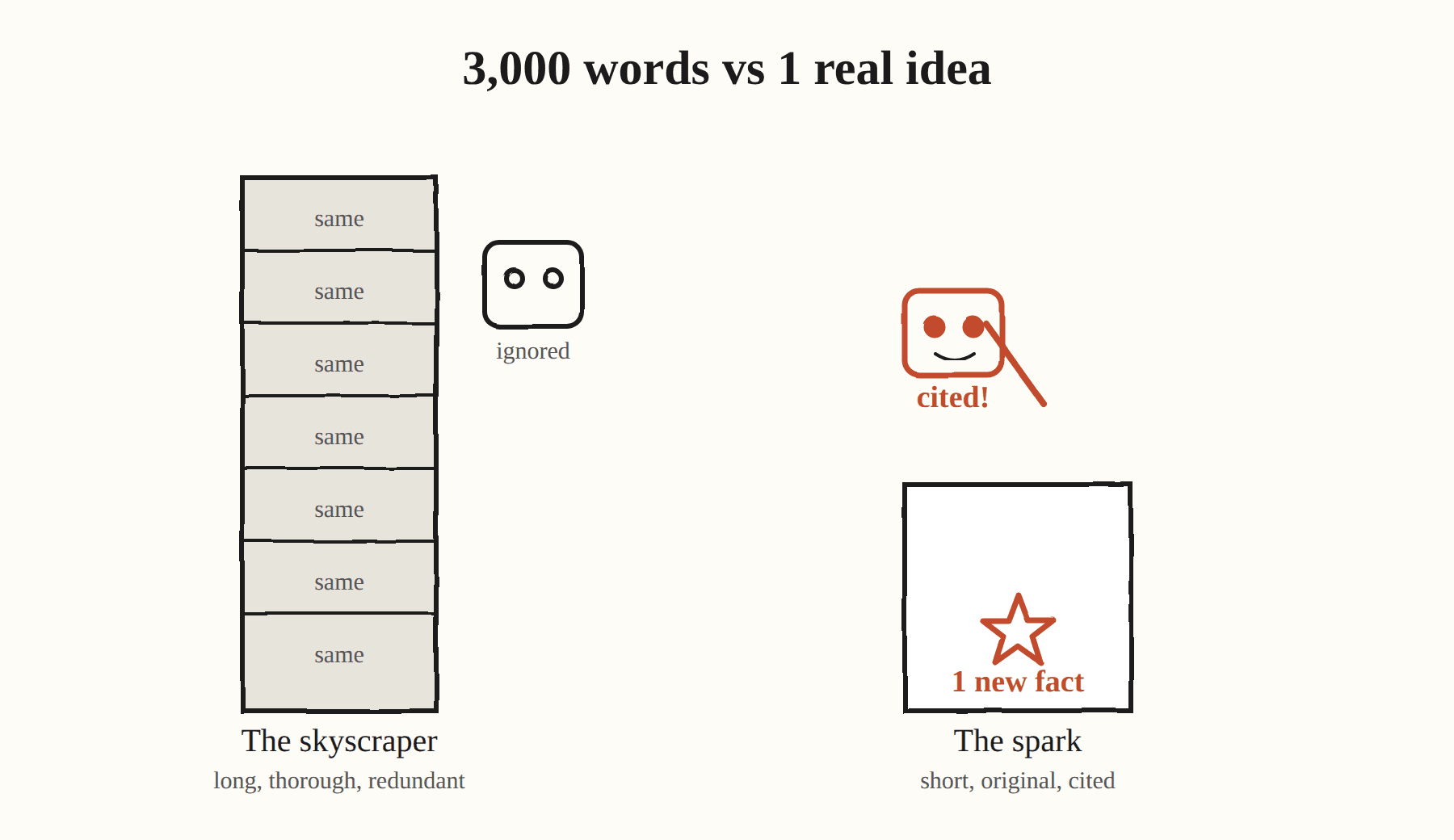
Building a longer, more complete version of the top result used to win. AI treats that same move as redundancy before you hit publish. A 600-word post with one genuinely new data point gets cited over a 3,000-word rehash. And when you do have an original insight, burying it under 2,400 words of generic setup works against you - engines lift dense, extractable novelty, not pages that hide it.
A 2025 reality check keeps this honest. C-SEO Bench (Puerto et al., NeurIPS 2025) tested the popular prompt-engineering “GEO tricks” and found most are ineffective - several actively hurt - and the gains shrink toward zero as everyone adopts them. What survives is real source quality and real relevance. There’s no clever hack for having nothing new to say.
What we’re seeing at Relevant.ai
We build AI-visibility tracking with GEO recommendations - in plain terms, we watch where brands actually get cited across generative engines, then tell them what to fix. One pattern keeps repeating in our early tests: pages that ranked perfectly well in classic search were simply absent from the AI answer for the similar query prompt. Trace it back and the cause was almost always the same - the content was derivative. Clean, well-structured, well-optimised, and saying nothing the other ten sources didn’t already say.
Small sample, early days, but consistent enough that we now audit for it first.
Your Next Move - Start Here on next Monday
- Count your zero-gain pages. If a page just repeats the consensus, the AI already has it and doesn’t need you.
- Manufacture novelty on purpose. Proprietary data, original frameworks, first-party results. Give the engine a reason you’re the source.
- Make every passage stand alone. Engines lift paragraphs, not whole pages. If a line needs three others to make sense, it won’t get quoted.
- Attribute every claim. A stat with a named source is machine-readable proof you’re worth citing.
FIELD NOTE
Backlinks measured who was willing to vouch for you. Information gain measures whether you were worth reading in the first place.
So, one question for your team this week: what’s your zero-gain page count?
PS: Written to practise what it preaches: every external figure is attributed, each section stands on its own, and the claim density is deliberately high. That structure is itself a GEO technique.
Sources
- Google Patent US 11,354,342 B2 — “Contextual estimation of link information gain,” granted 7 June 2022. patents.google.com/patent/US11354342B2
- P. Aggarwal et al., “GEO: Generative Engine Optimization,” Proc. KDD 2024 (Princeton). arxiv.org/abs/2311.09735
- H. Puerto et al., “C-SEO Bench: Does Conversational SEO Work?” NeurIPS 2025 (Datasets & Benchmarks). arxiv.org/abs/2506.11097