
How ChatGPT and other LLMs Decide Which Brands to Recommend
October 8, 2026 · 8 min read
TL;DR
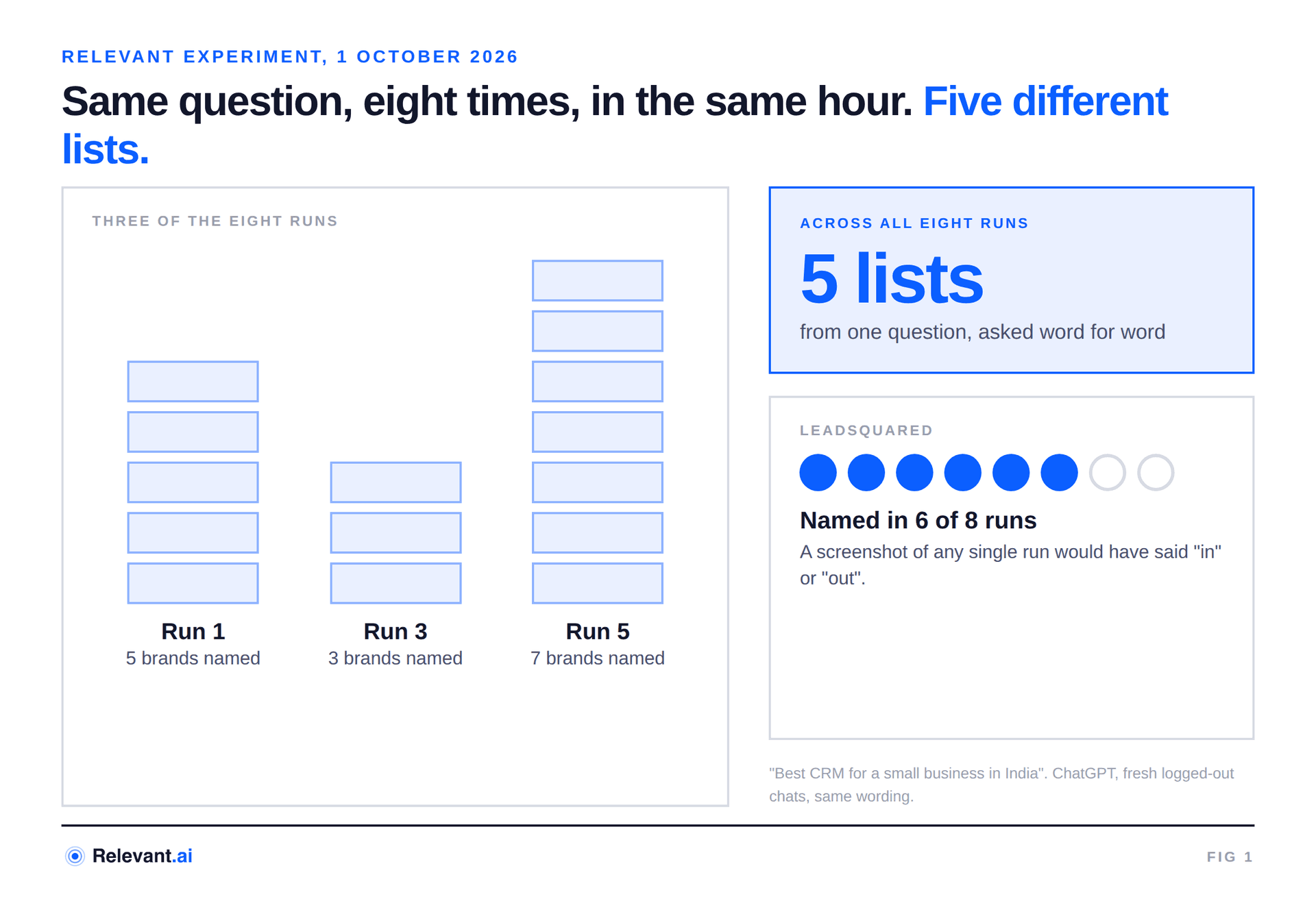
We asked ChatGPT the same question eight times on the same day, in fresh logged-out chats. We got five different lists of brands.
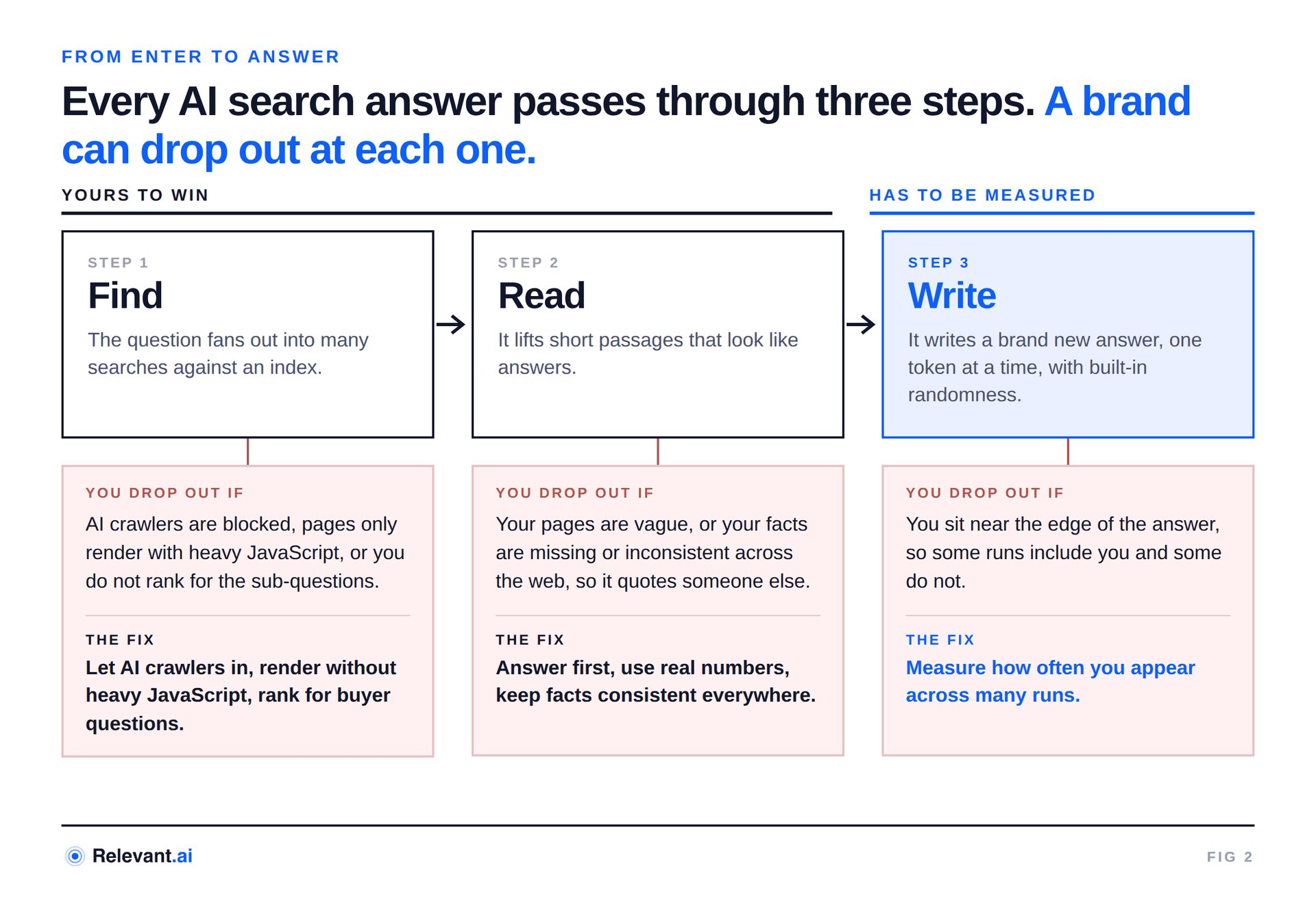
That is not a bug. Every AI search answer goes through three steps: it finds pages, reads passages, then writes a brand new answer. A brand can drop out at each one.
The first two steps are yours to win: be fetchable, and be quotable. The third step is probabilistic, so it has to be measured as a rate, not a rank.
One screenshot of one answer tells you almost nothing about your visibility.
On 1 October 2026 we asked ChatGPT one question eight times: what is the best CRM for a small business in India? Same wording, a fresh chat each time, logged out, all within the same hour.
The first run named five brands. The third named three. The fifth named seven. Across eight runs we got five different lists. Nothing about those companies changed in that hour. So what did?
To answer that you have to follow a question from the moment someone hits enter to the moment an answer appears. It passes through three steps, and each one has its own way of losing you.
Where does an AI's knowledge come from?
There are two sources, and they behave very differently.
- Memory. Before release, a model is trained on a large snapshot of the web. What it learned is baked in. The snapshot has a cutoff, it can be out of date, and nobody outside the lab can edit it. If the web said something wrong about you two years ago, it may still be in there.
- Live search. ChatGPT search, Perplexity, Google AI Overviews and AI Mode can look things up at the moment of the question. They search, read a handful of pages, and write the answer from what they found.
Most answers about brands, products and prices blend both. Live search is the part you can actually influence, so the rest of this piece follows it.
Step 1: How does AI search find pages?
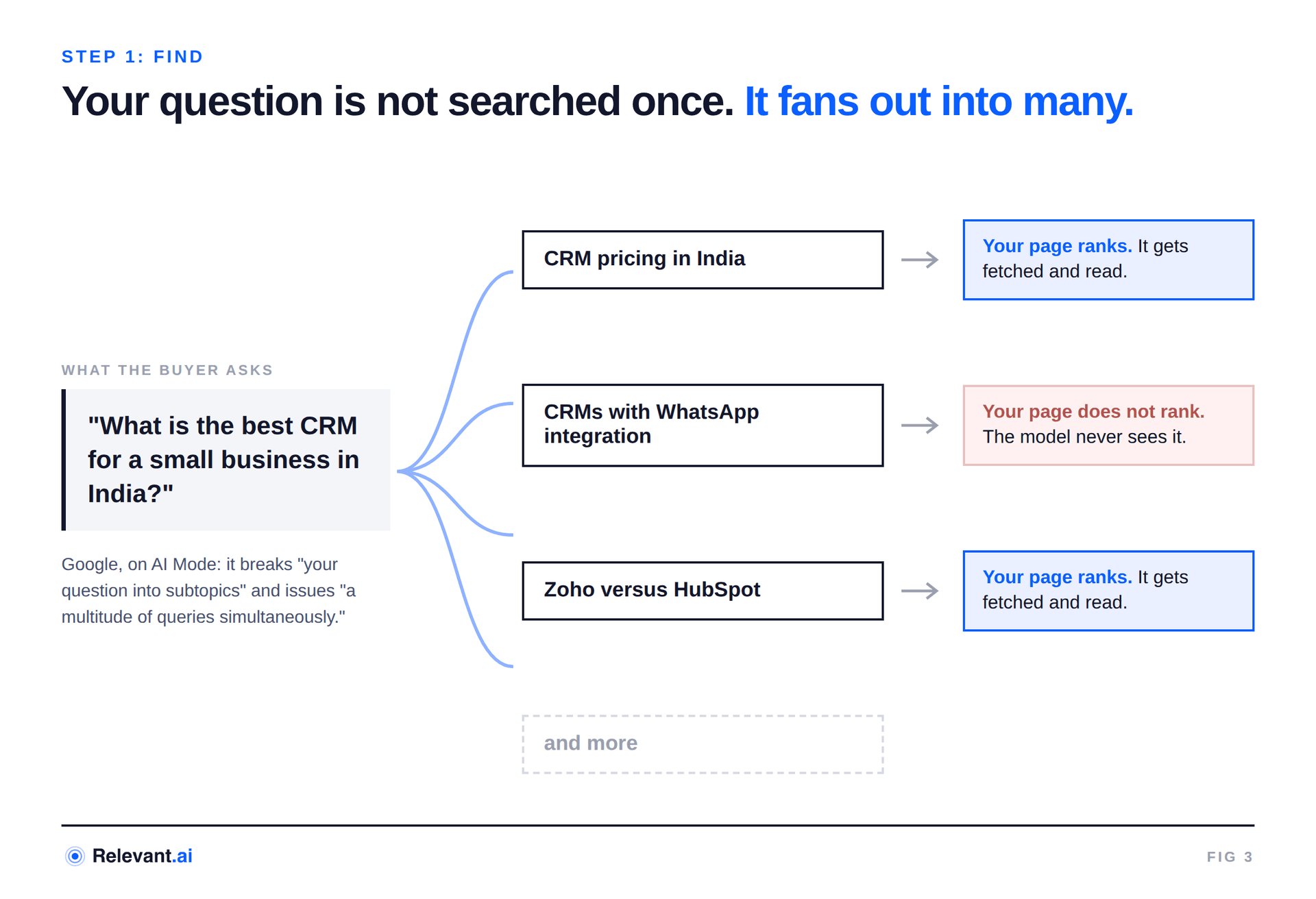
The first surprise is that your question is not searched once.
Google calls it query fan-out. In its own words, AI Mode breaks "your question into subtopics" and issues "a multitude of queries simultaneously." Ask for the best CRM for a small business in India, and behind the scenes it may search for CRM pricing in India, CRMs with WhatsApp integration, Zoho versus HubSpot, and more.
Those searches run against an index. Google's AI uses Google's index. ChatGPT search uses outside search providers alongside its own crawler, OAI-SearchBot. Perplexity runs its own crawler too.
The consequence is blunt. If your page does not surface for those smaller searches, the model never sees it. It cannot quote a page it never fetched. That is why the old basics still matter: crawlable pages, indexed pages, and pages that rank for the specific questions buyers ask, not only for your brand name.
Step 2: What does AI actually read on a page?
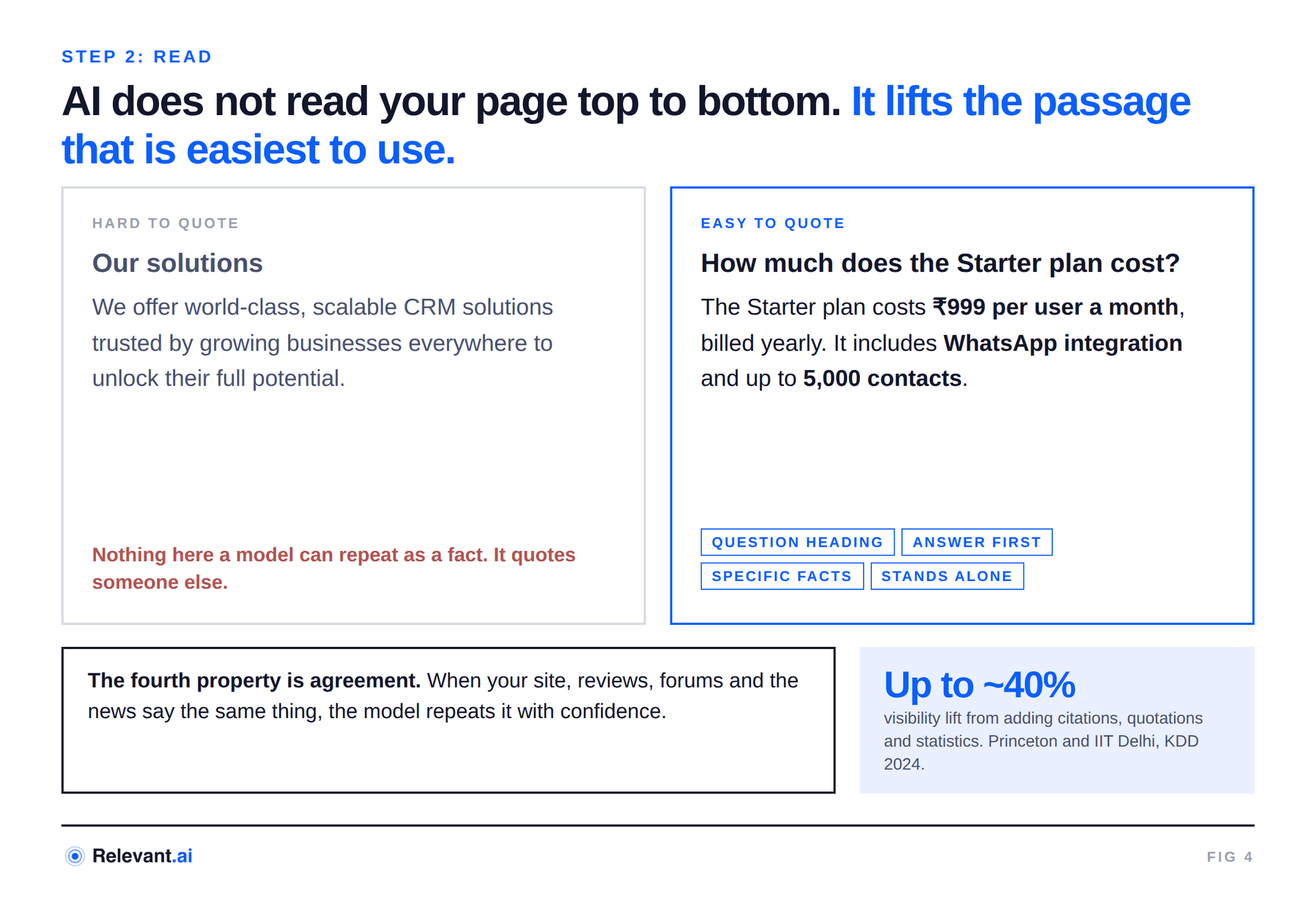
Now the system has a pile of pages. It does not read them top to bottom. It pulls out short passages that look like answers and leans on the ones that are easiest to use.
Four properties keep coming up:
- A direct answer, early. If the answer sits in the first couple of sentences under a heading, it is easy to lift.
- Specific facts. Prices, dates, numbers and names. "World-class solutions" gives a model nothing to repeat.
- Clear structure. Question-style headings, short paragraphs, lists and tables show where each answer starts and stops.
- Agreement. If your site, review sites, forums and the news say the same thing, the model can repeat it with confidence. If they disagree, it goes with the majority or hedges.
This is not folklore. In the first controlled study of generative engine optimisation, researchers from Princeton and IIT Delhi tested content changes across a benchmark of 10,000 queries. Adding citations, quotations and statistics lifted a source's visibility in generated answers by up to about 40%.
Step 3: Why does AI give a different answer every time?
The third step is where the vanishing brands come from.
A language model writes one token at a time, choosing each from a range of likely options. A little randomness is built in on purpose so the text does not sound mechanical. The side effect is that the same question can come back with different wording, a different order, and sometimes different brands. Location, language, earlier messages in the chat and the model version nudge it further.
The brands that came and went in our test were not broken. They were sitting near the edge of the answer, and on some runs it was written without them.
Weather forecasters live with this problem every day. A forecast model is sensitive to tiny differences in its starting conditions, so a single run can be confidently wrong. The European Centre for Medium-Range Weather Forecasts does not rely on one run. It runs the same forecast 51 times: one control run and 50 runs from slightly altered starting conditions. A 60% chance of rain means roughly 60% of the runs produced rain.
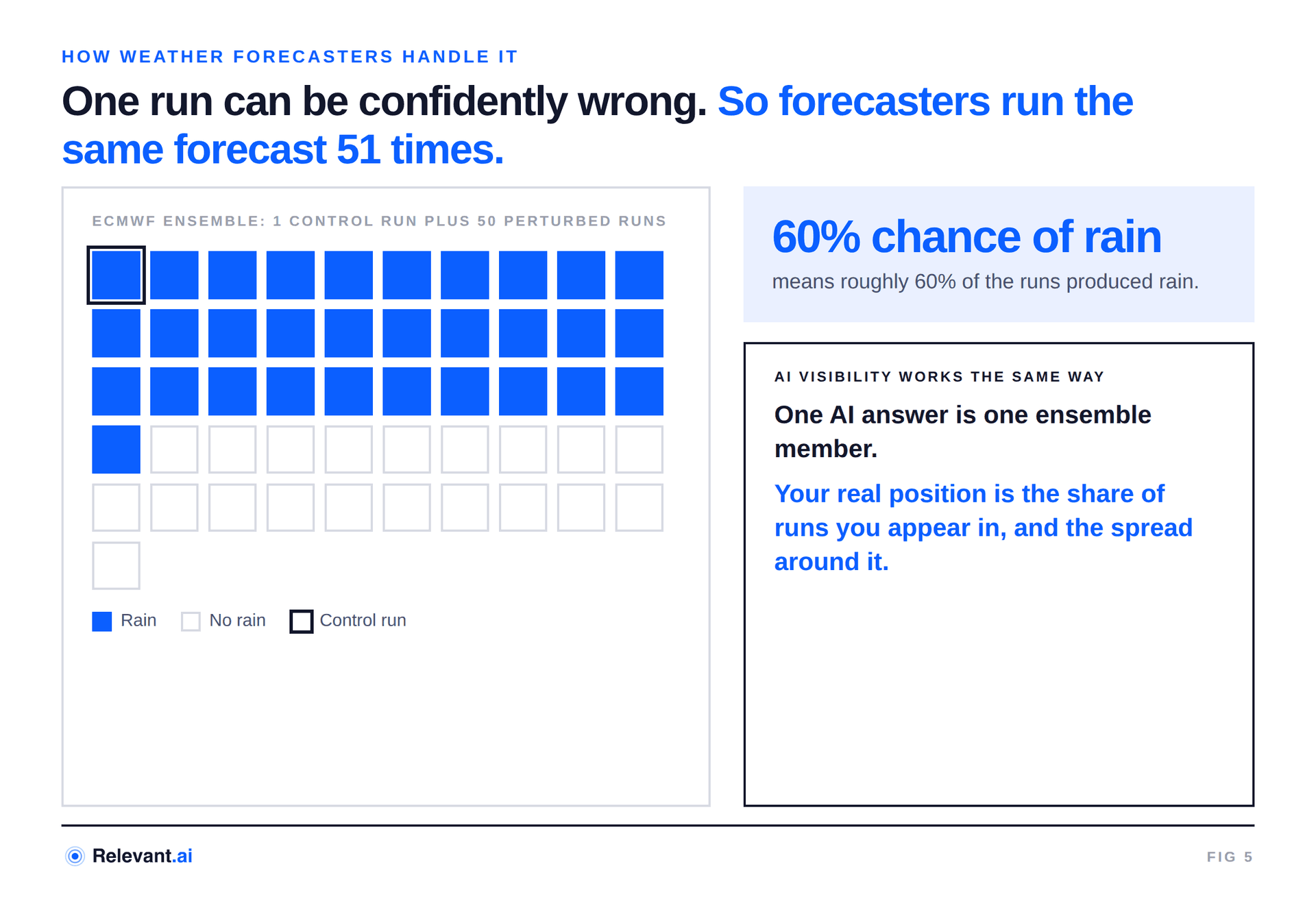
AI visibility works the same way. One answer is one ensemble member. Your real position is the share of runs you appear in, and the spread around it.
Where exactly do brands drop out?
Put the three steps together and the failure points become specific:
- At the find step: AI crawlers are blocked, key pages only render with heavy JavaScript, or you do not rank for the sub-questions. You are never fetched.
- At the read step: your pages are vague, so there is nothing worth quoting, and the model quotes someone else. If your facts are missing or inconsistent across the web, the model fills the gap from competitors, resellers or an old forum thread. Silence is not absence. Something always gets said.
- At the write step: even when you are in contention, you appear in some answers and not others.
What should you actually do?
1. Be findable. Let the AI search crawlers in. Make sure key pages load without heavy JavaScript. Rank for the specific questions buyers ask, not just your name.
2. Be quotable. Answer first. Use real numbers. Use question headings. Write passages that make sense on their own, out of context.
3. Be consistent. Your pricing, features and basic facts should say the same thing on your site, your listings, your review profiles and anywhere else people discuss you.
4. Measure a rate, not a rank. Ask the same questions many times, across engines, and track how often you appear.
Run the experiment on your own brand
You need a spreadsheet and some patience.
- Pick 10 to 20 real buyer questions from sales calls, support tickets and site search. Do not search your own name. Search the problem you solve.
- Run each question many times. Same wording, fresh chat, logged out, on ChatGPT, Perplexity and Google.
- Log every answer. Date, engine, brands named and their order, whether your site was linked, and anything it got wrong about you.
- Count rates, not wins. How often did you appear, and how often did each competitor? Repeat monthly on the same questions to build a baseline.
The honest caveat: small numbers lie
In our test, LeadSquared appeared in 6 of 8 runs. That reads as 75%. With only eight runs, the 95% range is roughly 41% to 93%. Had we run it 48 times and still seen 75%, the range would tighten to about 61% to 85%.
More runs do not change the answer. They tell you how much to trust it.
The harder limit is the one a spreadsheet cannot fix. You only measure the questions you already know about.
AI platforms do not publish how often each question is asked, so a hand-built tracker cannot tell you which topics carry real demand, or how much of that demand your prompts cover.
Questions people ask
- Can you rank #1 in ChatGPT? Not in the way you rank on Google. There is no fixed list. Each answer is written fresh, so the useful number is how often you appear across many runs.
- Does ChatGPT search use Google? No. ChatGPT search uses outside search providers and its own crawler, OAI-SearchBot. Google's AI Overviews and AI Mode use Google's own index.
- Why did my brand disappear from an AI answer? Usually because it sits near the edge of the answer, so some runs include it and some do not. Check it across many runs before assuming something changed.
- What makes a page more likely to be quoted by AI? A direct answer near the top, specific facts, clear question headings, and agreement between your site and third-party sources.
About Us
Relevant is the visibility layer for AI search: it tracks how leading models talk about your brand, and helps you earn a lasting place inside the answer. We run your buyers' questions many times across the major AI engines and report the spread, not a single screenshot. Prompt Volumes shows the estimated monthly demand for the topics in your industry, how that demand is trending, and how much of it your tracked prompts cover.
Sources
- Relevant experiment: ChatGPT, one prompt, 8 runs, fresh logged-out chats, 1 October 2026. 5 distinct brand lists; LeadSquared named in 6 of 8 runs. Intervals are 95% Wilson score intervals.
- Google, AI in Search: going beyond information to intelligence, Elizabeth Reid, 20 May 2025 (query fan-out).
- Google Search Central, AI features and your website.
- Aggarwal et al., GEO: Generative Engine Optimization, Princeton University and IIT Delhi, KDD 2024.
- OpenAI, Overview of OpenAI crawlers.
- ECMWF, ECMWF model description (51-member ensemble).