
A court says you can sue over AI lies. You almost certainly cannot prove one.
September 21, 2026 · 7 min read
TL;DR
In May 2026 a Munich court held Google responsible for false statements made by its AI Overview, finding the summary is Google's own content rather than a pointer to someone else's.
That settles who is liable. It does not solve how you prove what was said, and AI answers are non-deterministic, so the sentence that harmed you may never be produced again.
English common law spent centuries on exactly this shape of problem. Permanent statements were straightforward. Transient spoken ones were not, and courts demanded proof of specific damage instead.
In the Wolf River case, the company could name roughly $388,000 of cancelled contracts against a claim of $25 million in lost sales. The provable part is only the customers who explained why they left.
The practical consequence: the remedy now belongs to whoever kept a record, and that record cannot be created after the fact.
On 28 May 2026 the Regional Court of Munich decided case "26 O 869/26" and did something the search industry had assumed was years away. It held Google responsible for what its AI Overview said.
Two Munich publishers had been linked by an AI Overview to fraud, subscription traps and dubious business practices. The court found the AI had made claims that were not even present in the search results it was summarising.
It rejected the argument that Google was merely pointing at other people's content, noting that the system rewrites and judges results in its own words and according to its own structure, and that Google alone has influence over the AI's offering and the algorithms. A disclaimer telling users to verify things for themselves was held to be insufficient. Google was ordered to stop and to pay 80 percent of costs.
The ruling is not final and Google is appealing. Treat it as a direction of travel rather than settled law.
Most coverage stops there, at the question of who is responsible. The more useful question is the one the court did not have to answer.
How would you prove it?
In an ordinary defamation claim, the statement sits still. A newspaper page, a broadcast recording, a post with a timestamp. You point at it and everyone can see the same thing.
An AI answer does not sit still. Ask the same question twice and you may get two different answers. Ask it next week and the model has been updated. The sentence that damaged you may never be produced again in that form, by anyone.
Which means the defendant can say, entirely honestly, that they cannot reproduce it.
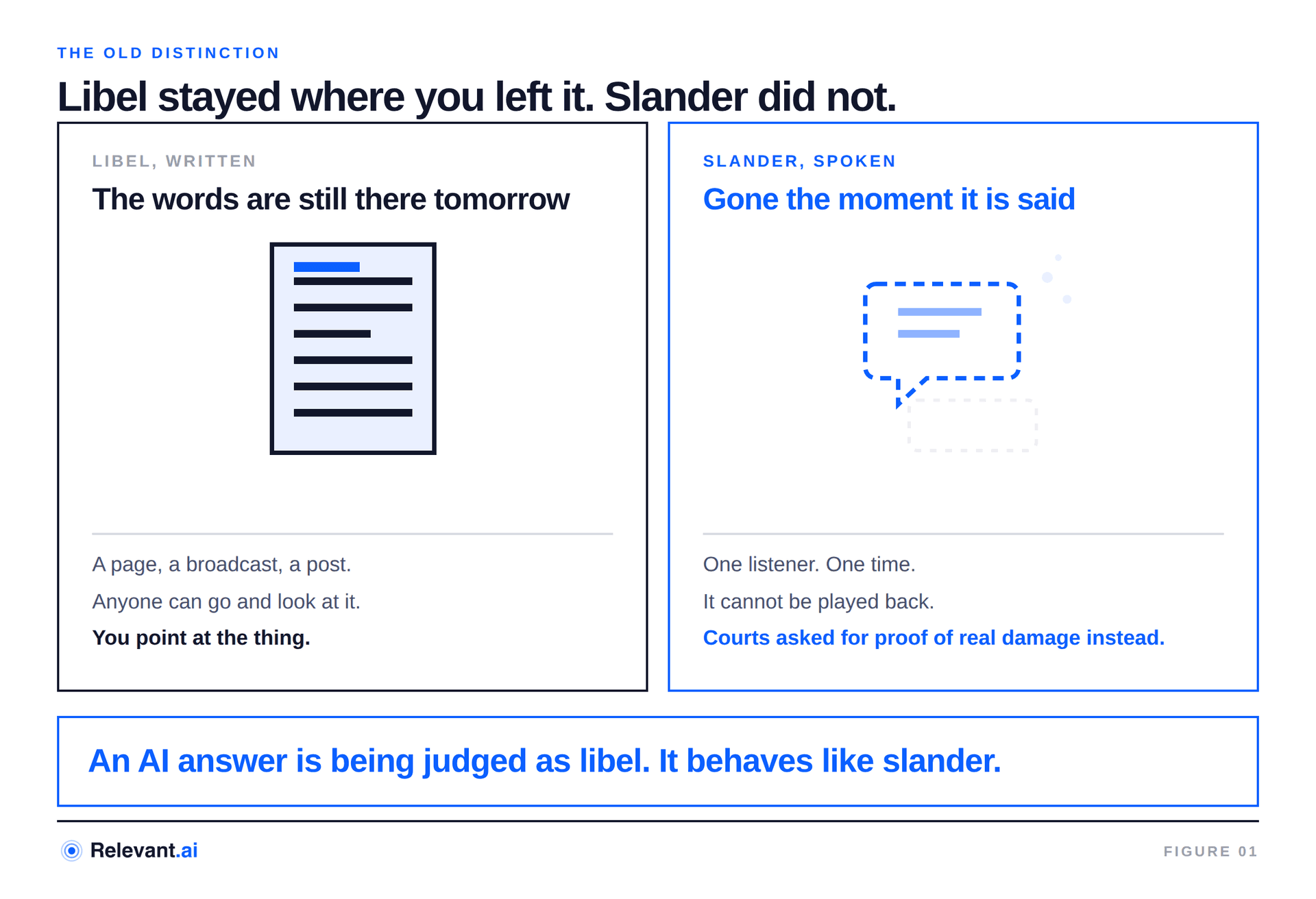
English common law has a name for this shape of problem, and it is far older than the internet.
Libel was written and permanent. Slander was spoken and gone. Libel was easier to act on because the words stayed where you left them. Slander was harder, and courts generally required proof of specific, actual damage, because there was nothing left to examine.
AI answers are being judged as libel. They behave like slander.
German law does not use those categories, so this is a conceptual parallel rather than a legal one. But it describes the practical problem exactly. The law has granted a remedy for a harm that erases itself.
What proof actually costs
The Minnesota case of Wolf River Electric shows the bill.
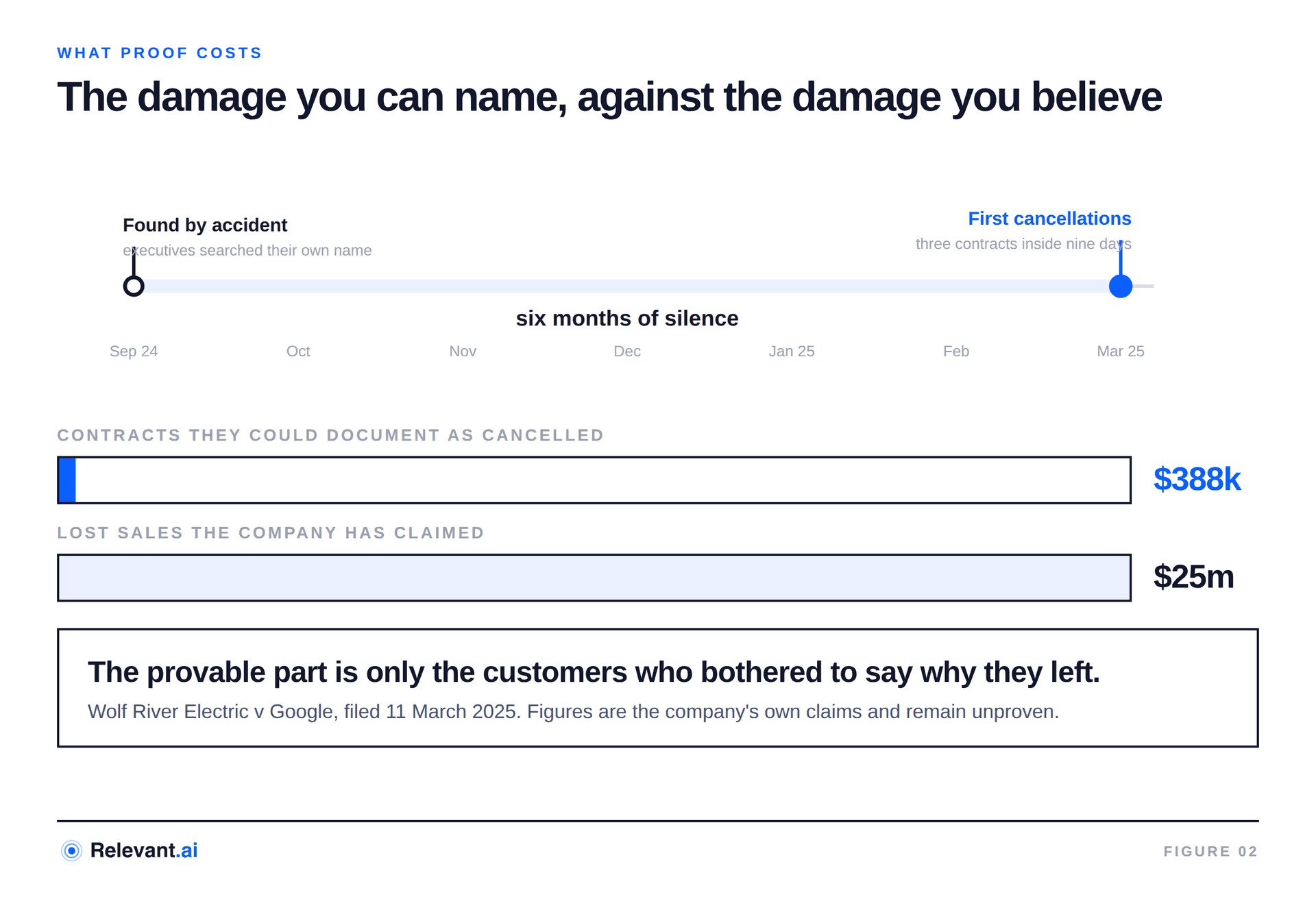
In September 2024, executives found an AI Overview stating that the company was facing a lawsuit from the Minnesota Attorney General over deceptive sales practices.
None of it was true!
The system attributed the claim to articles in the Star Tribune and to Attorney General press releases that said no such thing.
They found it by searching for their own company.
The first documented consequence arrived six months later.
A customer cancelled a $39,680 contract on 3 March 2025. Two days later another cancelled $150,000. Six days after that, a non-profit terminated $174,044 of work.
Add those up and you get about $388,000 in cancellations they could name. The company has claimed roughly $25 million in lost sales for 2024.
Look at that gap, because it is the real lesson.
The provable damage is the small fraction of customers who bothered to explain why they left. Everyone else read the answer, quietly decided against you, and never made contact. There is no cancellation email for the call that was never booked.
The uncomfortable arithmetic
Put the two cases together and a brand in this position needs three things.
- Evidence that the statement was made, on a specific date.
- Evidence that it happened more than once, because a single occurrence is an anecdote and a pattern is a claim.
- Evidence of harm, which is the hardest of the three, because most of your losses never identify themselves.
None of that exists unless somebody was recording at the time.
This is the part that quietly changes what measurement is for.
For the last two years, tracking AI answers has been sold as a marketing exercise. Share of voice, sentiment, a number that goes up and to the right. After Munich, the same activity produces something different: a dated, repeatable record of what a system said about you, and how often it said it.
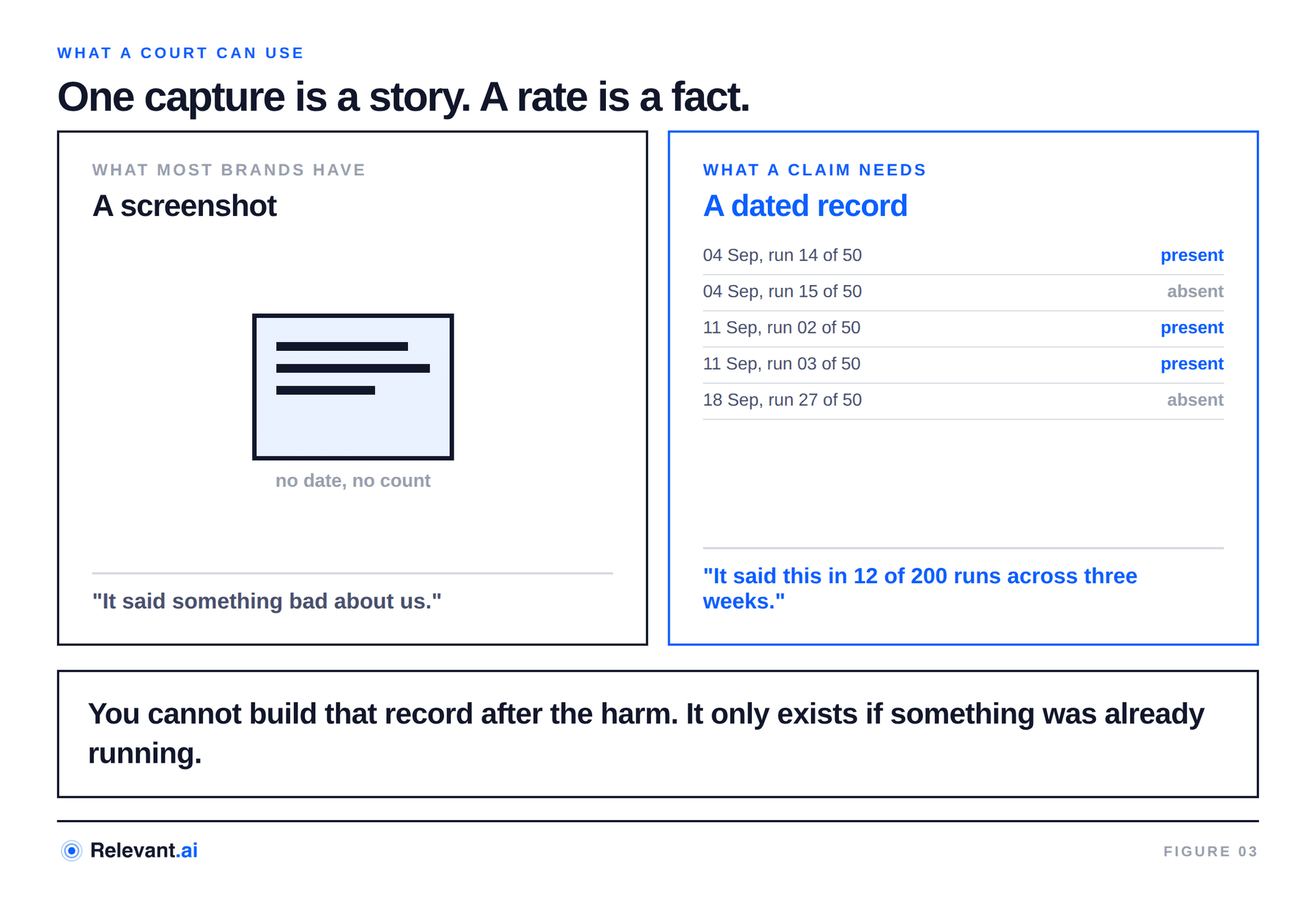
A screenshot is a story. An occurrence rate across two hundred runs, with dates and model versions, is closer to evidence.
That distinction did not matter much last year. It may matter a great deal next year.
What should companies actually do this quarter?
Four things, and none of them require a lawyer yet.
01. Log rather than screenshot
Capture the prompt, the full response, the model and version, the geography and the timestamp. A cropped image proves almost nothing about when the statement was made or how often it recurs.
02. Re-run everything
Frequency is the evidence. "It said this in 12 of 200 runs across three weeks" is a fact. "It said this once" is a complaint. Non-determinism cuts both ways, and the only answer to it is repetition.
03. Watch the legally loaded questions, not just the commercial ones
Most brands track some version of "best tool for X". Almost nobody tracks "is X a scam", "X lawsuit", "X complaints" or "is X legitimate". Those are the prompts that generate the claims a court would recognise, and they are usually absent from the reporting pack entirely.
04. Start before anything is wrong
You cannot construct a record of normal after the damage. Wolf River found their problem by accident, and by then the clock had been running for six months. A baseline is only worth something if it predates the thing you want to prove.
The honest caveats
The Munich ruling is under appeal. Wolf River is still contesting jurisdiction and has proved nothing yet. Nobody should build a strategy on the assumption that either outcome holds as it stands.
What is already true, regardless of how the appeals land, is this. A remedy is forming, and it will belong to whoever can show what was said and how often. That record cannot be made retroactively, and by the time you need it, the window to create it has closed.
The question worth asking your team this week
If an AI answer said something false about us tomorrow, what could we produce three months from now to prove it? If the answer is a screenshot somebody took on their phone, that is the gap.
About Us:
Relevant.ai is the scientific benchmark for your AI visibility score. We measure how AI answer engines describe your brand across prompts, personas and models, and report it with denominators, variance and confidence intervals rather than vanity scores.
Sources:
- Regional Court of Munich I (LG Munchen I), judgment of 28 May 2026, case 26 O 869/26, reported at BeckRS 2026, 11860. The ruling is under appeal.
- Full decision, translated: https://www.transparencycoalition.ai/news/german-court-holds-google-liable-for-ai-hallucination-read-the-full-decision-here
- News report: https://www.heise.de/en/news/LG-Munich-I-Google-ordered-to-pay-for-false-statements-in-AI-summaries-11327217.html (heise online)
- LTL LED, LLC et al v. Google LLC, case 0:25-cv-02394, US District Court for the District of Minnesota, originally filed 11 March 2025 in Ramsey County District Court. Remanded to state court in January 2026 after the removal was found untimely. Wolf River Electric is the trading name. All financial figures are the plaintiff's own claims and remain unproven.
- Complaint (PDF): https://ppc.land/content/files/2025/11/Wolf-River-Google-AI-Lawsuit.pdf
- Case background: https://ppc.land/minnesota-solar-company-sues-google-over-false-ai-generated-claims/ (PPC Land)