
The Zero-Click Reality: Why You Can't Just Slap "AI" on Your Legacy SEO Strategy
I've spent the better part of a decade with my hands inside machine learning systems - watching models tokenize, retrieve, rank, and reassemble human knowledge into something that reads like an answer. So when I sit in on conversations about AI search today, I get a very specific feeling. It's the feeling of watching a world-class chess player sit down at a poker table and open with the Sicilian Defense. Every move is technically excellent. None of it applies to the game being played.
The line I keep hearing from CEOs and CMOs is some version of this:"We already dominate Google. Our SEO is dialed in. We'll just point that same machine at AI and we're covered."
The instinct is understandable - it's the sensible, capital-efficient thing to believe. It's also, architecturally, a category error. The rest of this piece is my attempt to show why, using the actual numbers rather than the usual breathless claims. And the honest version of the argument turns out to be more persuasive than the hyped one - which is the whole reason I'm bothering to write it.
First, they are two different machines
Everything else follows from this, so it's worth being precise: search and generative AI are not two versions of the same thing. They are built to do opposite jobs.
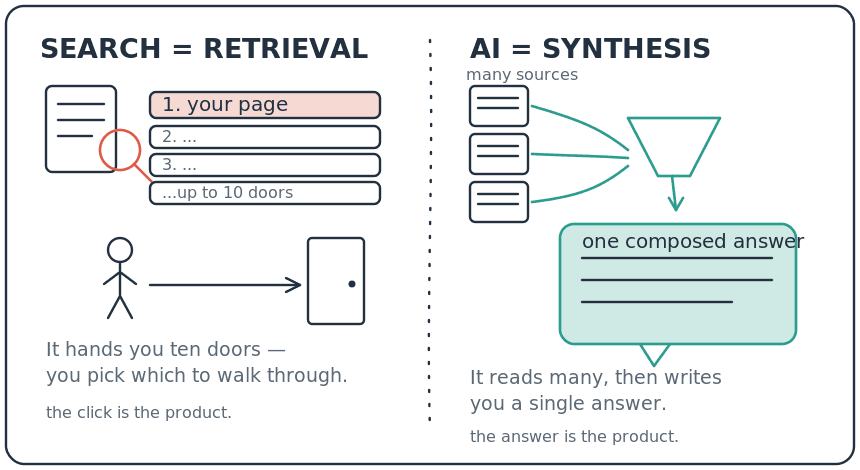
Traditional search is an information retrieval system. It takes your query, runs it against an index, and hands you a ranked list of doors to walk through. Its business model depends on the click - Google needs you to leave. So classic SEO is, at heart, the craft of being the loudest, most authoritative-looking door on the street.
A generative engine - ChatGPT, Perplexity, Gemini, Google's AI Overviews - is an information synthesis system. Retrieval-augmented generation pulls candidate passages from across the web and the model composes an answer from them. It has no structural need to send you anywhere. The click isn't the product; the answer is.
The cleanest way I can frame it: SEO optimizes to be findable in an index. GEO optimizes to survive compilation- to be one of the passages the model actually keeps when it collapses a dozen sources into three sentences. Same web, completely different target. And a page can win the first while losing the second badly.
So they reward completely different things
If they're different machines, they reward different signals - and here the research gets concrete. This is the point where I'd ask any skeptical operator to look at primary studies rather than a vendor's landing page.
In 2023 a team led by researchers at Princeton, with Georgia Tech, the Allen Institute for AI, and IIT Delhi, ran the first controlled study of this - "GEO: Generative Engine Optimization," later presented at KDD 2024. They built a 10,000-query benchmark and tested nine content tactics against a single question: what actually moves a page's visibility inside a generated answer?
The headline result: adding verifiable statistics lifted visibility in AI answers by roughly 41%, with citations and direct quotations close behind. The tactics that moved the needle least were the old reflexes - keyword-density optimization and its cousins - which are exactly what a legacy SEO playbook doubles down on.
Read that carefully, because it's the crux: your old SEO habits don't merely fail to transfer, some of them actively work against you. Great SEO doesn't put you 80% of the way to an AI strategy. It puts you in a different game.
Where the models pull their answers from confirms it. Somewhere between 57% and 88% of the sources cited in AI answers come fromoutsidethe traditional organic Top 10 - 57% in BrightEdge's 2025 look at AI Overviews, climbing toward 88% in Google's newer AI Mode.
(Note: I'm giving a range rather than one dramatic number on purpose: our own tests at Relevant show the real figure swings drastically with your industry, the AI engine, and depth of the queries evaluated. Anyone guaranteeing a single universal percentage is definitely selling you something!)
The uncomfortable translation: you can own the entire first page of Google and still be invisible to the model. Rank and citation have decoupled.
Which is why this isn't even your SEO team's problem
If the model isn't reading your rank, whatisit reading? Answer that honestly and you arrive somewhere most people in my field won't say out loud: the "GEO is just SEO" narrative is quietly doing harm - including to SEOs themselves. It has convinced businesses that AI visibility is purely an SEO task, to be dropped in the SEO team's backlog. That's going to fail people, and the mechanism explains why.
In traditional search, ranking for"best CRM tools"was something your SEO team could genuinely move - through content, technical foundations, and authority building. The lever sat inside your own domain. You controlled the page, so you could optimize the page.
A generative engine doesn't build its answer from your page alone. It synthesizes from consensus across the web - reviews, forums, comparison sites, third-party write-ups, the general drift of how people talk about you. So if your product carries poor reviews, weak sentiment, or a broadly negative reputation, no amount of on-page work will consistently earn you the model's recommendation.You cannot out-optimize a page for a reputation the model reads everywhere else.
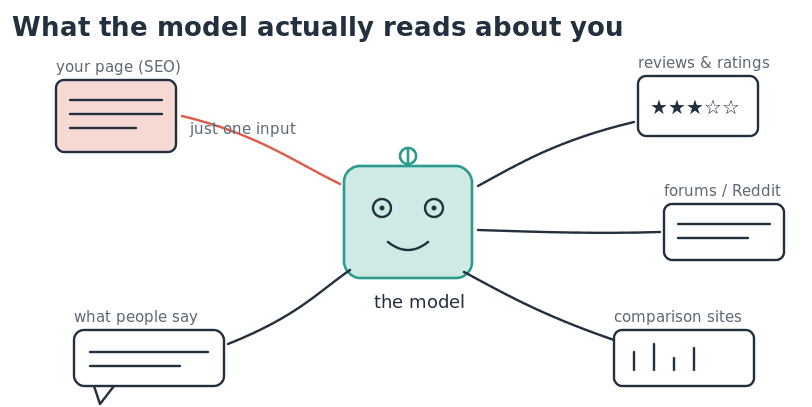
That's the real reframe: GEO isn't about optimizing pages, it's about optimizing the business. Whether a model recommends you is downstream of things that never touch a CMS - product quality, support experience, what customers say unprompted, whether third parties back your claims.
None of that demotes SEO; it's still what lets the model read you at all. It just means AI visibility is a business problem wearing a search interface, and it moves only with collaborative effort across functions. Treating it as something you can delegate downward and forget is the most expensive mistake I see right now.
And the traffic it does send behaves differently
Say you do the harder work and start earning citations. Is that traffic even worth chasing? Here I have to be careful, because this is exactly where GEO evangelism oversells.
You'll see the claim that AI-referred visitors convert at ~16% versus ~1.7% for organic. That pair is real - Seer Interactive's data, ChatGPT near 15.9%, Google organic near 1.76%. But it's one dataset, and the excited posts skip the counterweight: Amsive's paired analysis across 54 sites found LLM traffic did not convert significantly differently from organic once properly controlled. A 9x gap in one study shrinks to noise in another.
So what's actually true? Not "AI traffic is magic." The defensible, mechanism-level claim is narrower: someone who types a paragraph-long question into an assistant and reads back a synthesized recommendation is, on average, further down the funnel than someone typing three keywords into a box.
Where that intent gap is real - complex B2B purchases, considered decisions - the lift shows up (Amsive saw B2B convert 2.17% vs 1.16%). In commodity B2C it's still debatable, and I'd test across more domains before calling it.
The takeaway for a CEO isn't "chase the 16%." It's that a growing share of your highest-intent buyers now build their shortlist inside a model - and in the right segments that's valuable enough that ignoring it is a decision, not a default.
Except "ignoring it" assumes you can even see it
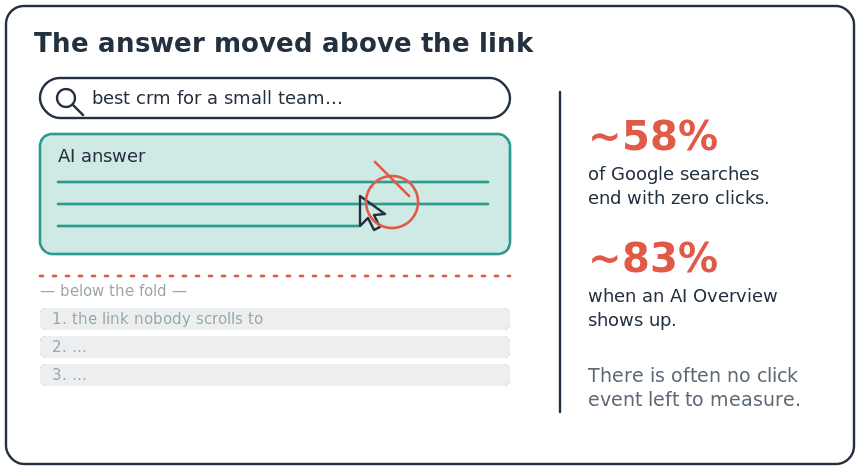
You can't - and this is the fact that quietly breaks the legacy dashboard. In 2025 roughly 58% of US Google searches ended with no click at all (Similarweb puts it near 69%), and among searches that trigger an AI Overview, about 83% end without one. The answer movedabovethe link. Much of the time there is no click event left to measure.
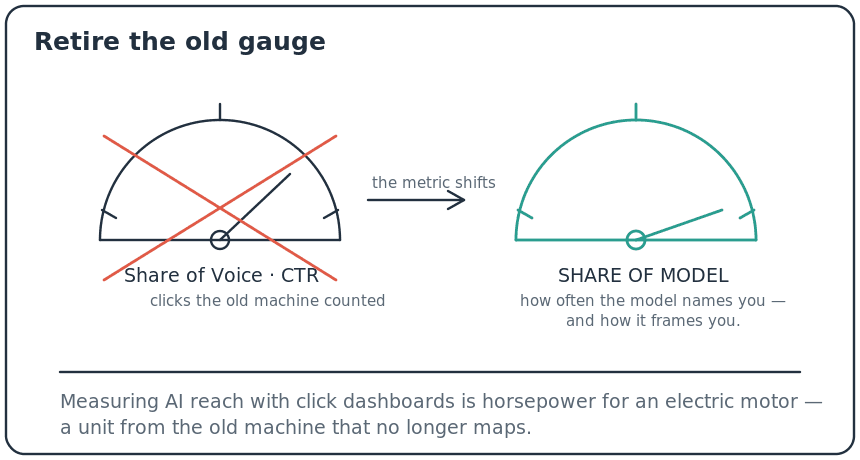
Which makes "Share of Voice" and "click-through rate" the horsepower of an electric motor - a unit inherited from the old machine that no longer maps. Run your board reviews off click-based dashboards and you're watching a shrinking window onto a growing room.
The metric that replaces them is Share of Model: when a model is asked about your category, how often is your brand in the answer - and how is it framed? That needs different instrumentation entirely - citation frequency across engines, how your brand is characterized in the generated text (not just whether it appears), whether your content is even structured so RAG can lift it cleanly. None of that lives in a rank tracker.
So where does this leave SEO?
Not dead - for sure! It's the plumbing - if a crawler can't reach and parse your site, none of the above matters, and that layer is squarely SEO's job. But plumbing isn't the same as being the water the model pours into the glass. GEO is the layer that decides whether the answer gets built out of your facts or your competitor's.
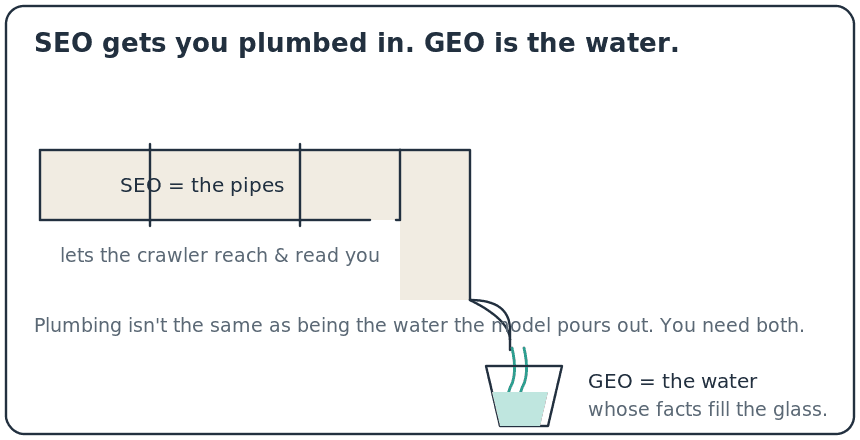
The shift has already happened on the demand side. A meaningful share of your customers have quietly outsourced the first draft of their decision to a model. The only open question is whose facts that draft is made of!
FIELD NOTE
A note on how I think about this, and a small disclosure.You'll have noticed I gave ranges and conflicting studies instead of one clean scary statistic. That's deliberate. This field is young, the measurement is genuinely hard, and most of what's published about GEO right now is confidence borrowed against data that doesn't exist yet. I'd rather be right slowly than loud quickly. That's also why my team and I have been heads-down on research before shipping anything. We're building Relevant - a system that defines what to track, helps in tracking your Share of Model, diagnosing the science behind why a model does or doesn't cite you, and testing fixes against real outcomes rather than just folklore. It isn't out yet, and that's on purpose: the last thing this space needs is another tracker throwing numbers on a chart with no idea whether they mean anything. We'd rather earn the claim first. If you care about this problem, keep an eye here - we'll put out our findings as transparently as we can.
Notes on the data
- Statistics/citations lift in AI answers (~41%): Aggarwal et al., "GEO: Generative Engine Optimization," Princeton / Georgia Tech / Allen Institute for AI / IIT Delhi, KDD 2024.
- Citations from outside the organic Top 10 (57%–88%): BrightEdge (2025) and studies of Google AI Mode.
- Conversion figures: Seer Interactive (~15.9% vs ~1.76%) and Amsive's 54-site paired analysis (no significant overall difference; B2B lift of 2.17% vs 1.16%).
- Zero-click rates (~58% overall; ~83% on AI-Overview searches): Similarweb (2025), Ahrefs, Semrush.
About the Author
With 10+ years deep in the tech and data science trenches, the author is currently building Relevant. When they aren't mapping the mechanics of AI search or building data-heavy inference models, they share unfiltered insights here on the future of search, demand modeling, and generative AI.